
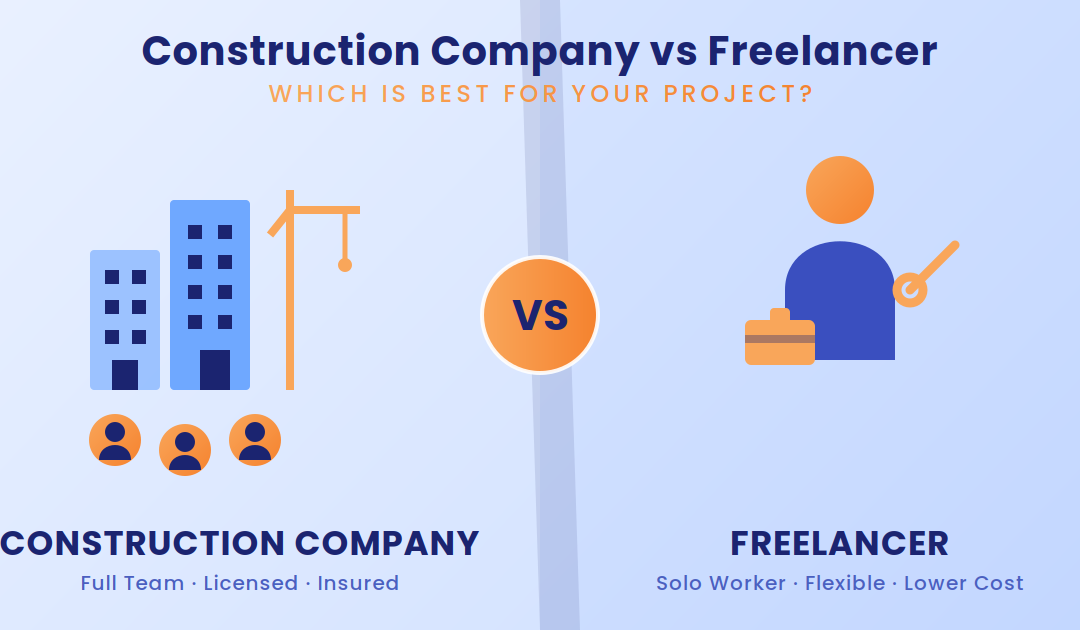
Choosing between a Construction Company vs freelancer is one’s personal choice but a licensed construction company is the safer choice for most building projects. It offers insurance, trained teams, legal protection, and after-service support. A freelancer works well for small, simple jobs like minor repairs or one-room touch-ups, but carries more risk for bigger projects. For anything involving structure, safety, or a real budget, a construction company like Senate Constructions gives you far more protection and peace of mind.
Building or renovating a property is one of the biggest decisions you will make. It costs real money. It takes real time. And it affects your safety.
So the question comes up again and again: should you hire a construction company or a freelancer?
Both options have a place. But they are not the same, and picking the wrong one can cost you thousands of dollars and months of stress.
This guide breaks down the real differences between a construction company and a freelancer. You will learn how they compare on cost, quality, safety, timelines, and long-term value. By the end, you will know exactly which one fits your project.
Many people search for this answer only after something has already gone wrong, like a delayed project or an unexpected repair bill. This guide is meant to help you decide before that happens, not after. Read through each section, or jump to the part that matters most for your situation using the headings below.
What Is a Construction Company and Features of a Construction company vs Freelancer
A construction company is a registered business that builds, renovates, or repairs properties. It usually has a team of workers, not just one person. This team can include project managers, engineers, electricians, plumbers, masons, and site supervisors.
A construction company handles the whole job from start to finish. This includes planning, permits, labor, materials, safety checks, and final handover.
Most construction companies are licensed and insured. This means the government has approved them to work, and they carry insurance in case something goes wrong on site. Linkedln
Key Features of a Construction Company
- A full team instead of one worker
- Business license and legal registration
- Insurance coverage for accidents and damage
- Access to heavy equipment and bulk materials
- A project manager who oversees the entire job
- Written contracts and formal agreements
- Warranty on completed work
Construction companies are built to handle projects of any size. This can range from a small bathroom remodel to a full commercial building.
What Is a Freelancer in Construction?
A freelancer is a single, independent worker who takes on construction jobs. This could be a carpenter, painter, electrician, or general handyman. Freelancers often work alone or with one or two helpers.
Freelancers usually do not run a registered company. Many work informally, without a business license or a team behind them. Some are highly skilled and experienced. Others are less experienced and take on work to build their portfolio.
Key Features of a Freelancer
- Works alone or with a very small team
- Lower overhead costs, which can mean lower prices
- Flexible schedule and direct communication
- Limited access to heavy machinery
- Often no formal insurance
- Best suited for small, simple tasks
Freelancers can be a good fit for small jobs. But they are not built to manage large or complex construction projects the way a full company is.
Pros and Cons of Hiring a Construction Company
Before going deeper, here is a quick reference list.
Pros:
- Full team with different skills in one place
- Licensed and often insured
- Project manager keeps everything on track
- Access to heavy equipment and bulk materials
- Warranty on finished work
- Better suited for large or complex jobs
Cons:
- Usually costs more upfront
- May take longer to start due to scheduling
- Less flexible for very small, quick tasks
- Requires a formal agreement and process
Pros and Cons of Hiring a Freelancer
Pros:
- Often cheaper for small jobs
- Flexible scheduling
- Direct, personal communication
- Can start quickly for simple tasks
Cons:
- Usually no insurance coverage
- No backup if the worker is unavailable
- Limited access to heavy equipment
- Rarely offers a formal warranty
- Not built for large or multi-trade projects
These lists are not about which option is “good” or “bad.” They show that each one fits different needs.
Construction Company vs Freelancer: Key Differences
Here is a side-by-side look at how the two options compare.
| Factor | Construction Company | Freelancer |
| Team size | Full team with specialists | Usually one person |
| Licensing | Licensed and registered | Often unlicensed |
| Insurance | Covered | Rarely covered |
| Cost | Higher upfront, safer long-term | Lower upfront, riskier long-term |
| Project management | Dedicated manager | Self-managed |
| Equipment | Owns or rents heavy equipment | Limited tools |
| Timeline | Structured schedule | Flexible but less predictable |
| Warranty | Usually included | Rarely offered |
| Best for | Medium to large projects | Small, simple tasks |
This table gives you the short version. Now let’s go deeper into each factor, because the details matter.
Cost Comparison: Construction Company vs Freelancer
Cost is usually the first thing people think about. And on paper, freelancers often look cheaper.
Why Freelancers Seem Cheaper
Freelancers have lower overhead. They do not pay for office space, a large payroll, or business insurance. This means they can charge less per hour or per project.
For small jobs, like painting a room or fixing a leaky faucet, this lower cost makes sense. The job is simple, and the risk is low.
Why Construction Companies Cost More, But Save Money Long-Term
A construction company charges more because it includes more. The price covers licensed labor, insurance, project management, and quality checks.
If something goes wrong, like a structural issue or an electrical fault, a construction company is legally responsible for fixing it. A freelancer, especially an unlicensed one, may not offer the same protection.
Hidden costs can also creep in with freelancers. If a freelancer makes a mistake, you may need to hire a company anyway to fix it. This means paying twice.
In short: freelancers can save money on small jobs. Construction companies save money on large projects by avoiding costly mistakes and delays.
A Simple Example of Hidden Costs
Imagine hiring a freelancer to install new wiring at a lower price than a licensed electrician from a construction company. If the wiring is not up to code, you may need to pay a licensed professional later to redo the work. You end up paying twice, and the total cost is higher than if you had hired a construction company from the start.
This does not mean every freelancer makes mistakes. It means the risk of paying twice is higher when there is no formal training check or supervision involved.
Quality of Work: Who Delivers Better Results?
Quality depends on skill, not just job title. A skilled freelancer can do excellent work. A poorly run construction company can also make mistakes.
But there is a structural difference in how quality is maintained.
Quality Control in Construction Companies
Construction companies usually have a system in place. This includes:
- Site supervisors who check work daily
- Safety inspections at each stage
- Standard building codes followed by trained staff
- Multiple team members reviewing the same job
This system catches mistakes early, before they become expensive problems.
Quality Control with Freelancers
A freelancer works alone. There is no second person checking their work. If they make an error, it may not be caught until later.
This does not mean freelancers do bad work. Many are very skilled. But there is less of a safety net if something goes wrong.
For small, visual tasks like painting, this risk is low. For structural work like foundations, wiring, or plumbing, this risk becomes serious.
Training and Certification
Many construction companies require their staff to hold certifications for specific trades, like electrical or gas work. This adds a layer of proven skill on top of daily supervision.
Freelancers may or may not hold formal certifications. Some have years of hands-on experience without formal papers. Others may be newer to the trade. Always ask directly about certifications for specialized work like electrical, gas, or structural tasks.
Licensing, Insurance, and Legal Protection
This is one of the biggest differences between a construction company and a freelancer, and it is often overlooked.
Why Licensing Matters
A licensed construction company has passed government checks. This proves they understand safety codes, building rules, and proper construction methods.
Many freelancers work without a license. This does not always mean they are unskilled. But it does mean there is no official body checking their qualifications.
Why Insurance Matters
Construction is physical work. Accidents can happen. Someone could get hurt. Property could get damaged.
A licensed construction company usually carries insurance. If an accident happens, the insurance covers the cost. You are protected.
Most freelancers do not carry business insurance. If something goes wrong on your property, you may have to pay for the damage yourself, even if it was not your fault.
What Happens If There Is a Dispute?
If a construction company fails to deliver, you have legal options. You can use your written contract to demand a fix or a refund.
With a freelancer, especially an informal one, there may be no contract at all. This makes it harder to prove what was agreed and harder to get your money back.
Project Timelines and Reliability
Timelines matter, especially if you are paying rent elsewhere or waiting to move in.
How Construction Companies Handle Timelines
A construction company usually gives you a project schedule. This includes start dates, milestones, and an expected finish date.
Because they have a full team, work can continue even if one person is sick or unavailable. Multiple workers can be on-site at once, speeding up the process.
How Freelancers Handle Timelines
A freelancer often works on multiple jobs at the same time. This can lead to delays, especially if another client’s job takes priority.
If a freelancer gets sick, injured, or simply too busy, your project can stall completely. There is no backup team to step in.
For small jobs, this may not matter much. For time-sensitive projects, this can become a real problem.
Communication and Project Management
Good communication prevents most construction problems.
Communication with a Construction Company
You usually have one main point of contact, like a project manager. This person updates you on progress, answers questions, and coordinates the team.
This structure keeps things organized, especially on larger projects with many moving parts.
Communication with a Freelancer
With a freelancer, you talk directly to the person doing the work. This can feel more personal and immediate.
But it also means all communication depends on one person. If they are busy working, they may be slow to respond to calls or messages.
For simple jobs, direct communication works well. For complex projects, it can lead to confusion without a formal system in place.
Handling Big or Complex Projects
This is where the gap between the two options becomes very clear.
Why Freelancers Struggle with Large Projects
Large projects need multiple skill sets at once. You may need an electrician, plumber, mason, and carpenter working together on a schedule.
A single freelancer usually cannot do all of this. They may need to bring in other freelancers, which adds coordination problems and can affect quality control.
Why Construction Companies Are Built for This
A construction company already has these specialists on staff or on call. They know how to schedule different trades so the work flows smoothly.
They also have access to heavy machinery, bulk material discounts, and safety equipment that a single freelancer usually cannot access.
If your project involves a new build, an extension, or major structural changes, a construction company is almost always the better fit.
Warranty and After-Service Support
What happens after the work is done matters just as much as the work itself.
Warranties from Construction Companies
Most construction companies offer a warranty. This means if something breaks or fails within a set period, they will fix it for free.
This gives you long-term protection and shows the company stands behind its work.
Warranties from Freelancers
Freelancers rarely offer formal warranties. If something goes wrong after the job is finished, you may need to pay again, either to the same freelancer or someone else, to fix it.
Some freelancers are honest and will return to fix mistakes. But without a written agreement, this depends entirely on trust.
Tools, Equipment, and Materials: Who Provides What?
Equipment and materials affect both cost and quality, so it helps to know who supplies what.
What Construction Companies Provide
Construction companies usually own or rent heavy machinery, like excavators, cranes, and scaffolding. They also buy materials in bulk, which often means lower prices per unit.
Because they work on many projects, they already have relationships with suppliers. This can speed up delivery times and reduce material costs passed on to you.
What Freelancers Provide
Most freelancers bring their own hand tools, like drills, saws, and basic equipment. For anything heavier, they usually need to rent machinery, which adds cost and time to the project.
Freelancers also buy materials in smaller amounts. This can mean higher prices per unit compared to a company buying in bulk.
If your project needs heavy equipment, this is another point in favor of a construction company.
Safety on the Job Site
Construction work involves real physical risk. Falls, electrical accidents, and heavy lifting injuries are common in this industry.
Safety Standards in Construction Companies
Licensed construction companies usually follow formal safety procedures. Workers may wear protective gear, and sites often have safety checks built into the daily routine.
This is not just about following rules. It protects workers, and it protects you and your property from accidents.
Safety Standards with Freelancers
Safety practices vary widely among freelancers. Some are very careful and experienced. Others may cut corners to save time or money, especially without a supervisor checking their work.
Before hiring a freelancer for any task involving heights, electrical work, or heavy lifting, ask directly about their safety practices and experience.
Common Myths About Freelancers vs Construction Companies
Some common beliefs about this topic are not fully true. Let’s clear a few up.
Myth: “Freelancers Always Do Worse Work Than Companies”
This is not accurate. Many freelancers are highly skilled, sometimes with more hands-on experience than newer construction company employees. Skill depends on the individual, not just the job title.
Myth: “Construction Companies Are Always Too Expensive”
Construction companies do often cost more upfront. But for larger projects, the cost of fixing freelancer mistakes, delays, or missing insurance can end up higher in total.
Myth: “You Don’t Need a Contract for Small Jobs”
Even small jobs benefit from a simple written agreement. It protects both sides and prevents misunderstandings about price, timeline, and scope of work.
Myth: “All Construction Companies Are the Same”
Quality varies between companies just like it does between freelancers. Always check licensing, reviews, and past projects before hiring any company.
Real-World Scenarios: Which Option Fits Best
Seeing real examples can make this decision easier.
Scenario 1: Painting a Single Room
This is a small, low-risk task. A skilled freelance painter can likely do a great job at a lower cost than a full construction company.
Scenario 2: Renovating a Kitchen
A kitchen renovation often involves plumbing, electrical work, and cabinetry all at once. This usually needs multiple trades working together, which fits a construction company’s structure better.
Scenario 3: Building a New Home
This is a large, complex project with permits, inspections, and many stages of work. A licensed construction company is almost always the right choice here.
Scenario 4: Fixing a Leaky Faucet
This is a small, quick repair. A freelance plumber can usually handle this task well without needing a full company.
Scenario 5: Adding a Second Floor to Your Home
This involves structural changes, engineering, and safety compliance. A construction company’s team and legal accountability make this a much safer choice than a single freelancer.
These examples show a clear pattern: smaller, simpler tasks fit freelancers well, while larger, structural, or multi-trade projects fit construction companies better.
Payment Structures: What to Expect|Construction Company vs Freelancer
How you pay can be just as important as how much you pay.
How Construction Companies Handle Payment
Most construction companies use a staged payment schedule. You pay a percentage upfront, then more at set milestones, like after the foundation is complete or after final inspection.
This structure protects you. You are not paying the full amount before the work is finished, and you can hold back payment if a stage is not done correctly.
How Freelancers Handle Payment
Freelancers often ask for payment upfront or in one lump sum after the job. Some may request a deposit before starting materials or work.
Without a written schedule, it can be harder to hold back payment if something goes wrong partway through. Always agree on payment terms in writing, even for a small freelance job.
Long-Term Value and Property Worth
The choice between a freelancer and a construction company can also affect your property’s value over time.
How Construction Companies Support Long-Term Value
Work completed by a licensed construction company usually meets local building codes. This matters if you ever sell your property, since inspectors and buyers often check for code-compliant work.
A clear paper trail, including contracts, permits, and warranties, can also make the sale process smoother and support a higher resale value.
How Freelancer Work Can Affect Long-Term Value
Work done without permits or code compliance can create problems later. Some buyers or inspectors may require proof that work was done correctly, and unpermitted work can even need to be redone before a sale goes through.
For small cosmetic work, like painting or minor repairs, this is rarely an issue. For structural or system-related work, it is worth thinking about the long-term paper trail, not just the immediate cost.
When Should You Hire a Freelancer?
Freelancers are not a bad choice. They are simply better suited to certain situations.
Consider a freelancer when:
- The job is small, like painting, minor repairs, or furniture assembly
- You have a very tight budget
- The task does not affect the structure or safety of the building
- You already know and trust the person from past work
- You do not need a formal contract or warranty
For these situations, a skilled freelancer can save you money without adding much risk.
When Should You Hire a Construction Company?
A construction company is the safer choice for anything bigger or more serious.
Consider a construction company when:
- You are building a new structure or major extension
- The project involves electrical, plumbing, or structural work
- You need permits and code compliance
- You want insurance protection in case of accidents
- You need multiple trades working together on a schedule
- You want a warranty on the finished work
- The project has a firm deadline
If your project checks any of these boxes, a licensed construction company reduces your risk significantly.
Top Construction Companies Worth Considering
If you have decided a construction company is the right choice, here are the types of firms worth researching in your area.
1. Senate Constructions Senate Constructions is a full-service construction company known for reliable project management, skilled trade teams, and quality craftsmanship. It handles everything from planning to final handover, making it a strong choice for homeowners and businesses that want a single, accountable team managing the entire project. You can reach them directly through their website for a consultation.
2. Regional Design-Build Firms These companies combine architecture and construction under one roof. This can simplify communication since one team handles both design and building.
3. Established General Contractors Look for firms with a long track record in your area. Years in business often reflect consistent quality and satisfied clients.
4. Specialty Renovation Companies If your project is focused on renovation rather than new construction, a company that specializes in remodels may offer more relevant experience.
5. Licensed Local Builders Smaller, locally licensed construction companies can offer a more personal touch while still providing the legal protection and team structure that freelancers lack.
When comparing companies, always check for a valid license, proof of insurance, and reviews from past clients.
How to Choose the Right Option for Your Project
Use this simple checklist before making a final decision.
Step 1: Define the Size of the Job
Small and cosmetic jobs lean toward freelancers. Structural or large-scale jobs lean toward construction companies.
Step 2: Check for Licensing and Insurance
Always ask for proof. If a worker cannot provide this, treat the job as higher risk.
Step 3: Ask for a Written Contract
A contract should include cost, timeline, materials, and what happens if something goes wrong.
Step 4: Review Past Work
Ask for photos, references, or reviews. This applies to both freelancers and companies.
Step 5: Compare at Least Two Quotes
This helps you understand fair pricing and spot red flags, like a quote that seems too low to be realistic.
Step 6: Confirm Warranty Terms
Ask directly: what happens if something fails after the work is done? A clear answer is a good sign.
Red Flags to Watch Out For
Whether you choose a freelancer or a construction company, watch for these warning signs.
Red Flags with Construction Companies
- No physical address or way to verify the business
- Cannot provide a license number when asked
- Refuses to put the agreement in writing
- Asks for full payment before any work starts
- Has no reviews or past projects to show you
- Pressures you to sign quickly without time to think
Red Flags with Freelancers
- Cannot explain their experience with your specific type of job
- Refuses to give any references or examples of past work
- Quotes a price far below every other estimate you received
- Has no way to handle permits if your project needs them
- Avoids answering questions about insurance or safety
- Wants full cash payment upfront with no receipt
If you notice several of these signs, it is worth pausing and considering other options, even if the price looks appealing.
Questions to Ask Before Signing Any Agreement
Before you commit to either option, ask these direct questions.
- What is included in this price, and what is not?
- What happens if the project takes longer than planned?
- Who is responsible if something is damaged during the work?
- Can you provide references from recent, similar projects?
- What is the payment schedule, and when are payments due?
- Is there a warranty, and how long does it last?
- Who handles permits and inspections, if needed?
A confident, clear answer to each question is a strong sign you are working with someone reliable, whether that is a freelancer or a construction company.
Final Verdict: Which Is Better? Construction Company or Freelancer
There is no single right answer for every situation. The best choice depends on your project.
For small, low-risk tasks, a freelancer can be a smart, budget-friendly option.
For anything involving structure, safety, permits, or a real investment of time and money, a construction company offers stronger protection. You get a team instead of one person, insurance instead of risk, and a warranty instead of hoping for the best.
If you are planning a serious build or renovation, working with an established construction company like Senate Constructions gives you the structure, accountability, and long-term support that a single freelancer usually cannot match.
Think of it this way: the size of the risk should match the size of the team you hire. A small, low-risk task can safely go to a skilled freelancer. A large, high-risk project deserves the full support of a licensed construction company. Matching the right option to the right job is the real key to a project that finishes on time, on budget, and without unwanted surprises.
Frequently Asked Questions
Is it cheaper to hire a freelancer than a construction company?
For small jobs, yes. Freelancers often charge less because they have lower overhead costs. For large or complex projects, a construction company can end up cheaper overall because it avoids costly mistakes and delays.
Do freelancers need a license to do construction work?
This depends on your local laws and the type of work. Some tasks require a license by law, especially electrical and plumbing work. Always check your local regulations before hiring.
Which is safer construction company or freelancer?
Generally, yes. Construction companies are more likely to carry insurance and follow safety codes. This reduces the risk to you if an accident or damage occurs on site.
Can a freelancer build a house?
A single freelancer usually cannot build a full house alone. Building a house needs multiple trades working together, which is why most people hire a construction company for new builds.
What should I ask a construction company before hiring them?
Ask about their license, insurance, past projects, timeline, payment schedule, and warranty. A trustworthy company will answer clearly and provide documents if asked.
How do I know if a freelancer is trustworthy?
Ask for references, check reviews if available, and request to see photos of past work. A written agreement, even a simple one, also helps protect both sides.
What is the biggest risk of hiring a freelancer for a large project?
The biggest risk is lack of insurance and lack of a backup team. If the freelancer is unavailable, injured, or makes a serious mistake, there may be no safety net to fix the problem.
Do construction companies offer free quotes?
Most reputable construction companies offer a free consultation or quote before starting work. This lets you compare costs and plans without any upfront commitment.
Is it better to hire one contractor for the whole project or separate freelancers for each task?
For most people, hiring one construction company is easier. It means one point of contact, one schedule, and one team responsible for the entire project, instead of coordinating several freelancers yourself.
Can I switch from a freelancer to a construction company partway through a project?
Yes, but it can add cost and delay. A new team needs time to review what has already been done before continuing. It is better to choose the right option before starting, if possible.
Do construction companies handle permits and inspections?
Most established construction companies handle permits and coordinate inspections as part of their service. This is often harder to manage on your own if you hire an individual freelancer.
How do I verify a construction company’s license and insurance?
Ask the company directly for their license number and insurance certificate. You can usually confirm a license through your local licensing board or government website.