
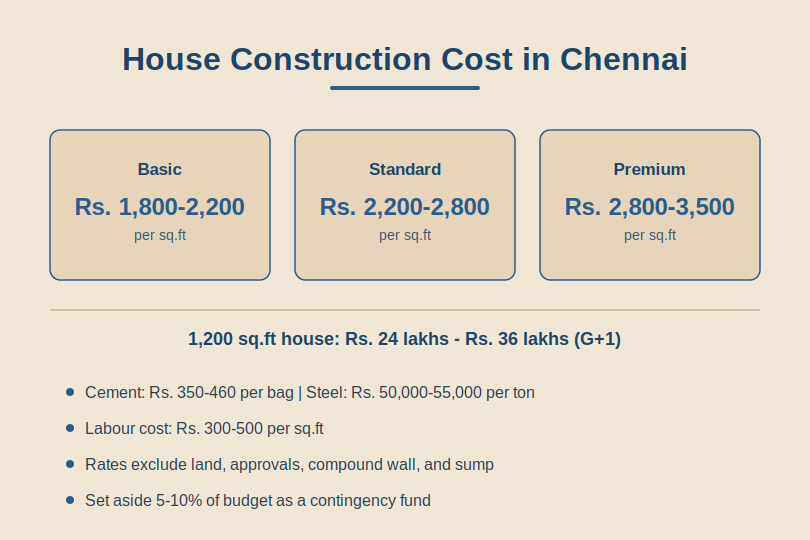
The cost to build a house in Chennai in 2026 costs between ₹1,800 and ₹3,500 per square foot, depending on the quality of materials and finish you choose. A basic home costs around ₹1,800–₹2,200 per sq ft, a standard home costs ₹2,200–₹2,800 per sq ft, and a premium or luxury home costs ₹2,800–₹3,500 per sq ft. For a 1,200 sq ft house, total construction cost usually falls between ₹24 lakhs and ₹40 lakhs, not including land price, government approvals, or interior furniture.
This guide breaks down everything in plain language. No confusing jargon. No vague numbers. Just clear facts you can use to plan your own home with confidence.
If you are planning to build a house in Chennai, this number is probably the first thing on your mind. It is a fair question. A house is one of the biggest purchases most people make in their life. Getting the budget wrong can cause stress, delays, and even unfinished construction.
What Decides building Construction Cost in Chennai - click here
Every house is different, so every cost is different too. But a few factors control most of the price. Once you understand these, you can predict your own budget fairly accurately.
Size of the house. Bigger homes cost more in total, but the cost per square foot often drops slightly as size increases. This happens because fixed costs, like site setup, get spread across a larger area.
Quality of materials. Cement, steel, tiles, and sanitary fittings come in different grades. A branded steel bar costs more than a local one. A vitrified tile floor costs more than a basic ceramic one. These choices add up fast.
Design complexity. A simple box-shaped house is cheaper to build than one with curved walls, multiple balconies, or a fancy elevation. Complex designs need more labour, more formwork, and more time.
Number of floors. A ground-plus-one (G+1) house costs less per square foot than a ground-plus-two (G+2) house. Extra floors need stronger columns, thicker beams, and a deeper foundation.
Soil condition. Chennai has different soil types across the city. Sandy or loose soil, common in areas near the coast and OMR, needs a deeper and stronger foundation. This adds to the cost before a single wall goes up.
Location within the city. Central areas like Anna Nagar or Adyar often have better access to labour and materials, which can lower logistics costs. Remote suburbs may add 5 to 10 percent extra for transport.
Contractor type. A full turnkey contractor who handles everything from design to handover usually charges a fixed rate per square foot. A labour-only contract can look cheaper on paper but often costs more once you count your own time, mistakes, and material wastage.
Average House Construction Cost Per Sq Ft in Chennai (2026)
Most builders in Chennai group their pricing into three or four tiers. Here is what you can expect in 2026.
Basic Construction cost to build a house in Chennai
Basic construction usually costs ₹1,800 to ₹2,200 per sq ft. This tier uses standard-grade materials, a simple elevation, and basic bathroom and kitchen fittings. It is a good fit if your main goal is a safe, functional home without extra frills.
A basic package usually includes RCC structure, brick walls, plastering, flooring with standard tiles, basic electrical wiring, and simple doors and windows. It does not usually include high-end brands or decorative elements.
Standard Construction cost to build a house in Chennai
Standard construction is the most popular choice in Chennai, priced around ₹2,200 to ₹2,800 per sq ft. This tier uses better-quality branded materials, a moderately styled elevation, and reliable finishing work.
Most middle-class families choose this tier because it balances cost and quality well. You get branded tiles, decent bathroom fittings, and a house that looks good without going over budget.
Premium Construction cost to build a house in Chennai
Premium construction costs ₹2,800 to ₹3,500 per sq ft, sometimes higher for very high-end specifications. This tier includes premium branded materials, a custom-designed elevation, and interior-ready finishing.
If you want imported tiles, designer lighting, false ceilings, or a modular kitchen included in the base package, expect the price to sit at the top of this range or beyond it.
Luxury Construction cost to build a house in Chennai
Some builders offer a luxury tier that goes up to ₹4,000 or even ₹5,000 per sq ft. This includes high-end architecture, smart home features, top-tier brands, and fully customized interiors. This tier is common for large independent villas and bungalows.
Total Cost to Build House in Chennai of Different Sizes
Knowing the rate per square foot is useful, but most people want to know the final number. Here is a size-wise breakdown using standard 2026 rates.
Cost to build a house in Chennai in 600 Sq Ft
A 600 sq ft house is a common size for a small independent home or a single-floor extension. Total cost usually ranges from ₹12 lakhs to ₹21 lakhs.
- Basic finish: ₹2,000–₹2,400 per sq ft → ₹12–14.4 lakhs
- Standard finish: ₹2,400–₹2,800 per sq ft → ₹14.4–16.8 lakhs
- Premium finish: ₹2,800–₹3,500 per sq ft → ₹16.8–21 lakhs
Cost to buils a house in Chennai in 1,000 Sq Ft
A 1,000 sq ft single-storey home typically costs between ₹18 lakhs and ₹28 lakhs.
- Basic tier: around ₹18–22 lakhs
- Standard tier: around ₹22–28 lakhs
This size works well for a small family and is one of the most searched house sizes in Chennai.
Cost to build a house in Chennai in 1,200 Sq Ft
This is one of the most common plot and house sizes in Chennai. A G+1 home with a reasonable standard or premium package usually costs ₹24 lakhs to ₹36 lakhs. If you go for a G+2 structure, expect ₹30 lakhs to ₹42 lakhs, since extra floors need stronger structural support.
Homes in premium central locations with luxury finishes can cost more. Homes in outer areas like Chengalpattu or Kanchipuram with basic finishes may come in slightly lower.
Cost to build a house in Chennai in 1,500 Sq Ft
A 1,500 sq ft G+1 home usually ranges from ₹30 lakhs to ₹45 lakhs, depending on the finish level chosen.
Cost to build a house in Chennai 2,000 Sq Ft
A 2,000 sq ft home, often built as G+1 or G+2, generally falls between ₹40 lakhs and ₹60 lakhs. Larger homes at this size often include more rooms, bigger balconies, and additional structural work, which pushes the total higher.
What Is Usually Included in the Per Sq Ft Rate
Not every quote means the same thing, so it helps to know what a standard construction package normally covers.
A typical package includes:
- Civil work: foundation, columns, beams, slabs, brick walls, and plastering
- Structural steel and cement work
- Roofing and waterproofing for the terrace
- Flooring with standard or branded tiles
- Electrical wiring, switches, and basic fittings
- Plumbing with CP fittings
- Doors and windows
- Interior and exterior painting
Higher-tier packages may add extras like waterproofing treatments, better bathroom brands, and upgraded flooring.
What is usually not included:
- Land cost
- Compound wall
- Underground water sump and overhead tank
- Electricity board (EB) connection
- Government approval and plan sanction fees
- Interior furniture and modular kitchen (unless specified)
- Landscaping and outdoor work
Always ask your builder for a clear list of inclusions and exclusions before signing a contract. This single step prevents most budget surprises later.
Material Cost Breakdown for House Construction in Chennai
Materials make up the largest share of construction cost. Here is a general idea of 2026 material prices in Chennai.
Cement: Around ₹350 to ₹460 per bag, depending on the brand and grade.
Steel (TMT bars): Roughly ₹50,000 to ₹55,000 per ton. Steel prices move often based on national market rates, so it is smart to check current rates before finalizing your budget.
Bricks or blocks: Prices vary by type. Red bricks, concrete blocks, and AAC blocks all have different rates and different strengths. AAC blocks cost more upfront but can reduce wall load and improve insulation.
Sand and aggregate: Prices depend on availability and government regulation on sand mining, which can affect supply in Tamil Nadu.
Tiles and flooring: Basic ceramic tiles start low, while vitrified and imported tiles cost significantly more per square foot.
Paint: Cost depends on brand and type, with exterior weatherproof paints costing more than standard interior paint.
Because material prices shift with the market, it is wise to lock in rates with your contractor in writing, especially for cement and steel, which make up a large share of total cost.
Labour Cost for House Construction in Chennai
Labour cost in Chennai generally ranges from ₹300 to ₹500 per sq ft, depending on the skill level required and the complexity of the work. Skilled work like electrical fitting, plumbing, and finishing carpentry costs more than general labour.
If you hire a full turnkey contractor, labour cost is usually built into the overall per square foot rate, so you do not need to manage it separately. If you go for a labour-only contract, you will need to hire and coordinate masons, electricians, plumbers, and painters yourself, which takes more time and carries more risk of delays.
Hidden and Additional Costs People Often Forget
Many homeowners calculate only the basic construction cost and get surprised later. A complete project budget should include these additional items.
Architect and design fees. Usually 2 to 5 percent of the total construction cost, depending on the architect and the complexity of the design.
Government approvals. Budget an extra ₹10 to ₹25 per sq ft for CMDA or local body plan approval, depending on your area and plot classification.
Compound wall. This is almost always charged separately and depends on the length and height of the wall around your plot.
Underground sump and overhead tank. Water storage systems are essential in Chennai and are usually priced as a separate line item.
EB connection. Getting an electricity board connection has its own government fee, separate from your construction contract.
Basement height adjustment. Most builders include a standard basement height, often around 3 feet, in their base package. If you need 5 feet, 6 feet, or more, expect extra charges, since this requires more filling material and structural work.
Soil-related foundation cost. If your plot has sandy or loose soil, common near OMR and coastal parts of Chennai, your foundation will need extra depth and strength. This can add ₹50 to ₹150 per sq ft to structural costs.
Contingency fund. Always set aside 5 to 10 percent of your total budget for unexpected costs. Construction rarely goes exactly as planned, and having a buffer prevents last-minute financial stress.
G+1 vs G+2: How Floor Count Changes the Cost
Adding a second floor is not simply double the cost of one floor. A G+2 structure needs a stronger foundation, thicker columns and beams, and an additional staircase, all designed to support the extra weight.
Because of this, the cost per square foot for a G+2 home is usually somewhat higher than a G+1 home of the same total area. If you plan to add a floor later, it is smart to design and build the foundation for future expansion from the start. This is usually cheaper than reinforcing an existing foundation years later.
How Location Within Chennai Affects Construction Cost
Chennai is a large city, and prices are not uniform everywhere.
Central and well-connected areas like Anna Nagar, Adyar, Velachery, and T. Nagar often have better access to skilled labour, established suppliers, and shorter transport routes for materials. This can keep logistics costs lower, even though land prices in these areas are usually higher.
Suburban and outer areas like Tambaram, Avadi, Chengalpattu, and Kanchipuram can sometimes see a 5 to 10 percent increase in logistics cost due to longer transport distances, though land prices are often lower, which can balance out your total budget.
Coastal and low-lying areas, including parts of OMR and ECR, often have sandy or loose soil, which increases foundation cost as mentioned earlier.
Some large turnkey builders apply the same per square foot package rate across most of Chennai, adjusting only for site-specific factors like soil condition and access. It is worth asking your builder directly whether their rate changes by area.
How to Calculate Your Own House Construction Cost
The basic formula is simple:
Construction Cost = Built-Up Area (sq ft) × Rate Per Sq Ft
Here is an example. Say you want to build a 1,500 sq ft home under a standard package priced at ₹2,500 per sq ft.
1,500 × ₹2,500 = ₹37,50,000
That gives you the base construction cost. Now add the extra items discussed earlier:
- Compound wall: budget separately based on plot perimeter
- Sump and overhead tank: separate line item
- EB connection: separate government fee
- Approval fees: roughly ₹10–₹25 per sq ft
- Architect fees: 2–5 percent of construction cost
- Contingency: 5–10 percent of total budget
Adding these on top of your base cost gives you a realistic, complete project budget instead of just the civil construction number.
One important note: plot area is not the same as construction area. A 1,200 sq ft plot does not mean a 1,200 sq ft house. Depending on setback rules and the number of floors, your actual built-up area could range from 1,100 to 2,400 sq ft. Always calculate your budget using built-up area, not plot area.
Ways to Reduce Construction Cost Without Losing Quality
Building a house does not have to drain your entire savings. Here are practical ways to manage cost sensibly.
Finalize your design before starting work. Changing plans midway causes rework, and rework almost always costs more than getting it right the first time.
Choose a simple structural design. A straightforward rectangular layout with a simple elevation is cheaper to build than one with curves, multiple levels, and complex angles.
Use locally manufactured materials where possible. Local bricks, tiles, and fittings often cost less than imported ones while still offering good durability.
Hire a reliable turnkey contractor with fixed pricing. A fixed-price contract protects you from mid-project price hikes and gives you a clear number to plan around.
Buy materials in bulk through your contractor. Established contractors often get better rates from suppliers due to bulk purchasing, which can bring down your overall cost compared to buying materials yourself in small quantities.
Avoid frequent design changes. Every change after work has started usually adds cost and time. Lock your design and stick to it.
Plan for future floors at the foundation stage. If you might add a floor later, design the foundation for it now. It is far cheaper than strengthening an existing structure afterward.
How Long Does It Take to Build a House in Chennai click here
Timeline is closely tied to budget, since delays often mean extra costs. For a 1,000 sq ft single-floor home, construction typically takes 6 to 9 months from foundation to handover, assuming approvals are already in place and there are no major design changes during construction.
Larger homes or G+2 structures naturally take longer, often 9 to 14 months, depending on design complexity and weather conditions. Chennai’s monsoon season can also slow down certain phases of work, so it helps to plan your construction start date with the weather in mind.
Should You Hire a Full Contractor or Manage Construction Yourself
This is one of the biggest decisions homeowners face, and it directly affects both cost and stress levels.
Full turnkey contractor. You get one point of contact, a fixed price, a written timeline, and accountability for quality. The contractor manages labour, materials, and coordination. This option usually costs the same as or less than self-managed construction once you account for wastage, mistakes, and the value of your own time.
Self-managed or labour-only construction. You hire masons, electricians, and plumbers separately and buy materials yourself. This can look cheaper on paper, but it requires constant supervision, strong technical knowledge, and the ability to resolve day-to-day site issues quickly. Without close supervision, material wastage and rework can quietly push costs higher than expected.
For most first-time homeowners, a reputed fixed-price contractor offers better predictability and peace of mind.
Documents and Approvals Needed Before You Start Building in Chennai
Before any construction begins, certain documents and approvals must be in place. Skipping this step can lead to fines, demolition notices, or trouble selling the property later.
Patta and Chitta. These are land ownership records issued by the Tamil Nadu government. You need them to prove legal ownership of the plot.
Encumbrance Certificate (EC). This document confirms the land is free from legal disputes or pending loans. Banks usually ask for this before approving a home loan.
Approved building plan. Your architect or structural engineer prepares the building plan, which then needs approval from CMDA (Chennai Metropolitan Development Authority) or the local panchayat or municipality, depending on your plot location.
Patta transfer, if applicable. If you recently bought the land, make sure the patta is transferred to your name before starting construction.
Soil test report. While not always mandatory, a soil test helps your engineer design the right foundation, especially in areas with sandy or loose soil.
Structural stability certificate. For larger homes, especially G+2 and above, a structural engineer’s certificate is often required as part of the approval process.
Getting these documents ready early avoids delays once construction starts. Many contractors offer support with approvals as part of their service, so ask your builder whether this is included in your package.
Home Loan and Financing for House Construction in Chennai
Most homeowners do not pay for construction entirely out of pocket. A construction loan from a bank or housing finance company is a common way to fund the project.
How construction loans work. Unlike a regular home loan, a construction loan is usually disbursed in stages, tied to the progress of your build. The bank releases funds after each stage, such as foundation completion, wall construction, roofing, and finishing, based on an engineer’s inspection report.
Documents banks typically ask for. These include the approved building plan, cost estimate from your architect or contractor, land ownership documents, and your income proof.
Interest during construction. Many banks charge only interest on the disbursed amount during the construction period, with full EMI starting once the loan is fully disbursed or the house is complete.
Tips for smoother loan approval. Keep your building plan CMDA-approved before applying, choose a contractor who can provide a clear, itemized cost estimate, and maintain a buffer in your loan amount for the additional costs mentioned earlier in this guide, such as compound wall and water sump.
Talk to more than one bank before finalizing, since interest rates and disbursement terms can vary. A construction-specific loan is usually better suited to this kind of project than a regular personal loan.
Interior and Finishing Costs After Civil Construction
The per square foot rate discussed earlier usually covers civil work and basic finishing. Many homeowners choose to spend additional money on interiors after the main structure is ready. Here is a general idea of what to expect.
Modular kitchen. Depending on size and material, a modular kitchen in Chennai can cost anywhere from ₹1.5 lakhs for a basic setup to ₹5 lakhs or more for a premium design with high-end finishes and appliances.
False ceiling. Gypsum false ceiling work typically costs ₹60 to ₹120 per sq ft, depending on design complexity.
Wardrobes. Built-in wardrobes usually range from ₹1,200 to ₹2,500 per sq ft of shutter area, depending on material and finish.
Painting upgrades. If you choose premium textured or designer paint over standard emulsion, expect an additional ₹15 to ₹40 per sq ft on top of the standard painting cost already included in your package.
Home automation and smart features. Basic smart lighting and switch systems can start around ₹50,000, while a fuller smart home setup can run into several lakhs depending on scope.
These interior costs are separate from your core construction budget, so it helps to plan for them from the start rather than treating them as an afterthought.
Common Mistakes to Avoid When Budgeting for House Construction
Many cost overruns happen not because of bad luck, but because of avoidable planning mistakes. Here are the most common ones seen in Chennai construction projects.
Confusing plot area with built-up area. As mentioned earlier, your house’s built-up area is often different from your plot size. Budgeting based on plot area alone leads to inaccurate numbers.
Ignoring exclusions in a quote. A low per square foot rate can look attractive, but if it excludes items like flooring upgrades, sump construction, or EB connection, your final bill can be much higher than expected. Always ask for a full inclusion and exclusion list in writing.
Skipping the contingency fund. Construction rarely goes exactly as planned. Price changes in steel or cement, unexpected soil conditions, or small design tweaks can all add cost. A 5 to 10 percent buffer protects you from financial stress.
Making frequent design changes mid-project. Every change after work begins usually means undoing completed work, which adds both cost and time. Finalize your design fully before construction starts.
Choosing the cheapest quote without checking quality. The lowest price is not always the best value. Check the contractor’s past projects, materials used, and client reviews before deciding based on price alone.
Not verifying approvals before starting. Building without proper CMDA or local body approval can lead to penalties or even demolition orders. Always confirm your building plan is approved before construction begins.
Top Construction Companies in Chennai for House Building
If you are looking for a trusted partner to build your home, here are well-known construction companies serving Chennai and surrounding areas.
- Senate Constructions (senateconstructions.com) — Known for transparent pricing, quality craftsmanship, and on-time project delivery across Chennai.
- Bluemoon Construction
- Siddharth Construction
- HireandBuild
- DEEJOS
- Lunazo Homes
Always compare at least two or three quotes, check past project photos, and speak with previous clients before signing a construction agreement. A written contract with clear inclusions, exclusions, and a payment schedule tied to project milestones protects both you and your builder.Linkedln
Pre-Construction Checklist for Building a House in Chennai
Before you break ground, it helps to run through a simple checklist. This keeps your project organized and reduces the chance of costly surprises later.
- Confirm land ownership documents, including patta, chitta, and encumbrance certificate
- Get a soil test done, especially if your plot is near the coast or a low-lying area
- Finalize your architectural and structural design completely before starting
- Get your building plan approved by CMDA or the relevant local body
- Choose your construction package tier: basic, standard, premium, or luxury
- Get a detailed, itemized quote from at least two or three contractors
- Confirm what is included and excluded in each quote, in writing
- Set aside a contingency fund of 5 to 10 percent of your total budget
- Arrange financing or a construction loan if needed, before work begins
- Agree on a written payment schedule tied to construction milestones
- Set a realistic timeline with your contractor, accounting for the monsoon season
Working through this list before construction starts can save weeks of delay and lakhs of unexpected cost.
Vastu and Design Considerations That Can Affect Cost
Many homeowners in Chennai and across Tamil Nadu prefer to follow Vastu principles when designing their home. While Vastu itself does not directly cost money, certain design choices linked to it can influence your budget.
For example, specific room placements, entrance directions, or the position of the staircase may require adjustments to the standard structural layout. If your plot shape does not naturally align with preferred Vastu directions, your architect may need to design around the constraint, which can sometimes mean a slightly less efficient use of space or minor changes to the structural plan.
If Vastu is important to you, it is best to mention this to your architect at the very first design stage, rather than after the plan is finalized. Adjusting a design early is far cheaper than making changes once construction has started.
Why Working with a Local Chennai Builder Matters
Construction cost is not just about the price per square foot. It is also about how well your builder understands local conditions.
A builder with strong local experience in Chennai will already understand which areas have soil challenges, which local body handles approvals for your specific location, current material supplier rates in the city, and realistic timelines that account for Chennai’s monsoon pattern.
This local knowledge often prevents costly mistakes that an inexperienced or out-of-town contractor might make, such as underestimating foundation needs in coastal soil or missing a local approval requirement. When comparing quotes, do not just look at the number. Ask about the contractor’s experience with projects similar to yours, in areas similar to your plot’s location.
Final Thoughts
House construction cost in Chennai in 2026 generally falls between ₹1,800 and ₹3,500 per square foot, depending on the quality tier you choose. For a typical 1,200 sq ft home, total budget usually lands between ₹24 lakhs and ₹40 lakhs, excluding land and interiors.
The real key to staying on budget is planning ahead. Finalize your design early, understand what your quote includes and excludes, set aside a contingency fund, and choose a contractor who offers fixed, transparent pricing. With the right planning, building your home in Chennai can be a smooth and predictable process instead of a stressful one.
Frequently Asked Questions
What is the average construction cost per sq ft in Chennai in 2026?
The average construction cost per sq ft in Chennai in 2026 ranges from ₹1,800 for basic finish to ₹3,500 for premium and luxury finish. Standard mid-range construction typically falls between ₹2,200 and ₹2,800 per sq ft.
How much does it cost to build a 1,200 sq ft house in Chennai?
A 1,200 sq ft house in Chennai typically costs between ₹24 lakhs and ₹36 lakhs for a G+1 structure with standard to premium finishes, and slightly more for a G+2 structure.
Does the cost to build a house include land price?
No. Construction cost per sq ft covers only the building work. Land price, government approvals, compound wall, water sump, and EB connection are usually charged separately.
Why cost to build a house vary across different areas of Chennai?
Cost can vary due to soil condition, distance from material suppliers, and local labour availability. Coastal and low-lying areas often need deeper foundations, which adds to structural cost.
Is it cheaper to hire a full contractor or manage construction myself?
A full turnkey contractor with fixed pricing is usually equal to or cheaper than self-managed construction once you account for material wastage, rework, and the time needed for daily supervision.
How long does it take to build a house in Chennai?
A single-floor home of around 1,000 sq ft usually takes 6 to 9 months to complete, provided approvals are ready and there are no major design changes during construction.
What is the difference between G+1 and G+2 construction cost?
G+2 construction generally costs more per square foot than G+1 because it needs a stronger foundation, thicker columns and beams, and an additional staircase to support the extra floor.
What additional costs should I budget for besides the per sq ft rate?
Budget separately for compound wall, underground water sump, overhead tank, EB connection, government approval fees, architect fees, and a contingency fund of 5 to 10 percent of your total budget.
Can I get a loan for house construction in Chennai?
Yes. Most banks and housing finance companies offer construction loans, disbursed in stages based on project progress. You will typically need an approved building plan, a cost estimate, and land ownership documents to apply.
How much does interior work cost after construction is complete?
Interior costs depend heavily on choices. A modular kitchen can range from ₹1.5 lakhs to ₹5 lakhs, false ceilings cost ₹60 to ₹120 per sq ft, and built-in wardrobes typically cost ₹1,200 to ₹2,500 per sq ft of shutter area.
What documents do I need before starting construction in Chennai?
You generally need the patta and chitta, an encumbrance certificate, an approved building plan from CMDA or the local body, and, for larger homes, a structural stability certificate.